• Skip to primary navigation
  • Skip to main content
Earmark CPE

Earmark CPE

Earn CPE Anytime, Anywhere

  • Home
  • App
    • Pricing
    • Web App
    • Download iOS
    • Download Android
    • Release Notes
  • Webinars
  • Podcast
  • Blog
  • FAQ
  • Authors
  • Sponsors
  • About
    • Press
  • Careers
  • Contact
  • Show Search
Hide Search

The Accounting Podcast

The Two Metrics That Can Double Your Accounting Firm’s Value in One Year, According to a Top Broker

Blake Oliver · May 29, 2024 ·

What if you could double your accounting firm’s value in a single year? Brannon Poe, a broker who’s handled over 500 firm sales, says it’s possible with the right strategic changes. 

In a recent podcast interview, Poe revealed that firms of any size can transform to maximize value and position themselves as attractive acquisitions by understanding what buyers want. The secret, he says, lies in mastering two key metrics.

We’ll unpack Poe’s road-tested insights on the levers of firm value and see how one traditional practice achieved a staggering valuation increase with clever strategic shifts. Whether you aim to sell soon or build a more valuable business, Poe’s wisdom will show you the way.

The Two Metrics That Move the Valuation Needle

Want to supercharge your accounting firm’s value? Brannon Poe says zeroing in on two key metrics can have an outsized impact.

1. Cash Flow to Owner  

“I always tell people, I’ve got two metrics. If you focus on these two metrics alone, you will increase the value of your firm,” Poe explains. “Cash flow to owner is probably number one.”

Your bullseye? For firms under $1.5 million in revenue, pushing cash flow to 50% or more of revenue. To calculate it, add your profit, owner compensation, and owner perks. For example, if your firm earns $1 million in revenue and your cash flow is $500,000, you’re right on target. The higher your cash flow margin, the more attractive your firm looks to buyers.

2. Owner Hours

“Owner hours is the other thing,” says Poe. “If you want the owner hours to be lower, lower is better – at least under 2000. But I have seen very well-systematized virtual firms get into the 500 mark for an owner. So you’re creating a real business at that point.” 

Minimizing owner hours reduces key-person risk and makes your firm more transferable. Buyers hesitate to acquire firms dependent on grueling owner hours, but a firm that runs smoothly with minimal owner involvement garners premium offers. 

Poe notes that adopting subscription pricing can drive progress on both fronts. Steady, recurring revenue and systematized work help boost margins while trimming owner hours. 

By lasering in on lifting cash flow and reducing owner involvement, firms of any size can transform into highly valuable, transferable assets. Next, we’ll see how one traditional firm put these principles into action to stunning effect.

From Surviving to Thriving: A Case Study in Strategic Transformation

The story of one husband-wife firm perfectly illustrates how powerful Brannon Poe’s value-boosting principles can be – even for small, traditional practices. 

Starting Point: A Traditional Firm in Need of Change

When the owners first approached Poe, they ran a classic mom-and-pop shop generating $1.2 million in annual revenue. Feeling overworked, underpaid, and unsure if they could keep going, they turned to Poe for help.

The Transformation Game Plan

Working with Poe, the owners implemented three key changes:

  1. Fired unprofitable clients: To free up much-needed capacity, the firm shed about 100 clients that drained time and resources but delivered minimal profits. 
  2. Raised prices: As Poe puts it, “If you don’t like your practice, keep increasing the prices until you like your practice.”
  3. Embraced subscription pricing: Transitioning clients, especially bookkeeping customers, to a recurring subscription model provided a steady, profitable revenue base.
  4. Launched advisory services: The firm created packaged advisory offerings and bundled them into subscription plans, enabling premium pricing.

Stunning Results in Just One Year  

The transformation was dramatic and swift. In just 12 months, the firm:

  • Increased annual revenue to $1.6-1.7 million
  • Expanded margins as new recurring revenue flowed to the bottom line  
  • Reduced owner hours while increasing employee pay
  • Landed an all-cash deal at their full $2 million asking price

The Power of Strategic Transformation

This firm’s journey embodies the incredible potential of Poe’s approach. By lasering in on profitability, recurring revenue, and owner efficiency, they morphed from a floundering traditional practice into a high-value strategic asset – in just one year. 

The Roadmap to a Firm That Works for You

This story powerfully illustrates that transforming your firm doesn’t have to take decades. With relentless focus on the right drivers, even tiny traditional practices can utterly rewrite their futures in under a year.

The key is strategically designing your transformation around buyers’ wants: powerhouse profitability with minimized owner dependence. Adopting the recurring revenue model, shedding margin-draining clients, and productizing premium advisory services are shortcuts for getting there faster.

Poe envisions a future where firm owners don’t have to choose between a profitable practice and a livable life. By architecting businesses that thrive without their constant oversight, owners can boost their bottom lines, free their schedules, and create thriving firms that are valuable today – and sellable tomorrow.

If you’re ready to build a practice that funds your ideal lifestyle now while setting you up for a profitable exit whenever you’re ready, the roadmap is clear – and it starts with learning everything you can from the best in the business. Take the first step now by listening to the full interview with Brannon Poe.
Harnessing AI’s Power to Transform Your Firm (No Coding Required)

Earmark Team · May 27, 2024 ·

You’re sipping your morning coffee, scrolling through your inbox, when you see it – yet another anxious client email asking about their tax return status. You sigh, knowing the next 15 minutes will be spent digging through practice management software and crafting a reply. But what if there was a better way?

In a recent episode of The Accounting Podcast, hosts Blake Oliver and David Leary reveal how they’re using AI at their company, Earmark, to boost productivity and client service without resorting to fee hikes.

Their big idea? By strategically integrating AI into your existing processes and datasets, you can unlock massive efficiency gains, deliver proactive client communication, and increase profits – without charging a penny more.

In this deep dive, we’ll explore two key themes from Blake and David’s AI playbook:

  • The AI Pricing Paradox: Is “smarter” software a justification for higher fees, or a tool for doing more with less?
  • The Power of Practical AI: How no-code tools like Zapier can help you automate routine client communication by connecting siloed data.

Along the way, we’ll challenge some common AI misconceptions and share actionable tips for kickstarting your own AI experiments. Let’s get started!

The AI Pricing Paradox: Efficiency Driver or Fee Inflator?

A recent Thomson Reuters survey found that 40% of tax pros believe AI will enable them to charge higher fees, with a bold 2% even predicting “significant” rate bumps.

But as early AI adopters, Blake and David aren’t buying the hype. In their experience, AI’s magic is its ability to supercharge efficiency, not justify steeper invoices.

“At Earmark, we’re seeing AI drive 4-8x productivity gains,” Blake reports. “That means we can slash labor costs and pass those savings on to clients.”

Rather than inflating prices, they see AI as a powerful deflationary force, exerting downward pressure on fees as more firms reap its efficiency rewards.

Cutting Through the AI Fog

So, what explains the chasm between the survey respondents’ bullish predictions and Blake and David’s more measured take? They chalk it up to a simple truth: many accountants haven’t logged enough hands-on hours with AI to separate hype from hard-won insight.

In other words, the survey likely captures more AI daydreams than real-world road tests.

Bidding Billable Hours Farewell?

Looking ahead, Blake and David predict AI’s relentless efficiency march will sound the death knell for billable hours, forcing firms to embrace flat-fee and value-based pricing.

Imagine an AI-augmented staffer cranking out in one hour what used to take eight. The old “bill-for-time” model crumbles fast in that brave new world.

Forward-thinking firm leaders proactively align their pricing with delivered value, not logged hours, positioning themselves to thrive in an AI-transformed marketplace. Luddites clinging to the billable hour risk being left in the dust.

The Power of Practical AI: Automating Client Comms with Zapier

Pop quiz: what’s the one email every accountant dreads? If you guessed “client asking for a status update,” you’re not alone. But what if you could banish those pesky requests for good without lifting a finger?

Enter Blake’s ingenious AI hack, courtesy of the no-code automation platform Zapier. With just a few affordable tools and clever stitching, he conjured an AI assistant that auto-responds to client status checks – no human intervention required.

Anatomy of an AI Email Wizard

Here’s a peek under the hood of Blake’s automation magic:

  • A client sends a status request email
  • Zapier AI parses the sender’s address
  • AI matches the address to the client database (in this case, a Google Sheet)
  • Presto! AI plucks client info like name, return status, and open items
  • AI whips up a bespoke email with all the key details, fires it off to the client

The best part? The whole thing unfolds in seconds, without an accountant lifting a finger.

Slashing Labor Costs, One Zap at a Time

Let’s do some back-of-napkin math. Manually checking a return status and pecking out an update could easily take 15 minutes. Multiply that by dozens of pings from antsy clients, and you’re wasting hours.

Blake’s AI sidekick liberates your team for higher-impact (and higher-profit) work. Even better, by proactively pinging clients, you can short-circuit many requests before they hit your inbox.

Anyone Can Build an AI Assistant

You don’t need a computer science degree or a seven-figure software budget to conjure your own client comms wizard. As long as your client data lives in a structured format (yes, even a Google Sheet), you can sic an AI on it to automate those repetitive pings.

Case in point: Blake spun up his prototype in under an hour.

Your AI Swiss Army Knife

Once you’ve caught the automation bug, the possibilities are endless:

  • Pinging clients about missing paperwork
  • Generating fee quotes and engagement letters
  • Confirming estimated tax payments

If it’s a predictable client exchange, there’s a good chance AI can handle it. Think of every minute you’ll save – and every billable hour you’ll free up – by outsourcing those routine pings to your AI email genie.

AI as a Catalyst for Reinventing the Billing Model

But AI’s true potential lies not in isolated tools, but in its power to reimagine firms from the spreadsheets up. In an industry sickened by a dwindling talent pool and the specter of commoditization, smart automation could be a potent antidote, freeing weary accountants to rediscover the strategic magic that drew them to the profession in the first place.

Imagine an AI-powered firm where every employee is a virtual CFO, unencumbered by the drudgery of data entry and free to build deep client relationships. AI, in other words, could be the catalyst for a new golden age of accounting – but only if we’re brave enough to change.

Embarking on Your AI Journey

The AI revolution is no longer a distant dream for accounting firms – it’s a present-day reality full of potential for those ready to embrace it. The question is not if your firm will adopt AI, but when and to what extent.

If you’re eager to start with AI, the best approach is to start small. Choose a single process and focus on automating it. Blake and David’s podcast offers a practical, actionable blueprint for implementing your first AI workflow in a week.

The path to a more efficient, profitable, and fulfilling accounting future begins with a single automated process, a single minute saved, and a single client impressed. The choice is yours: will you watch from the sidelines as others reap the benefits of AI, or will you take the helm and chart your course?

The opportunity is here, and the future is bright. Your AI journey awaits – it’s up to you to take the first step.

Embracing the Remote Work Paradigm in Accounting

Earmark Team · May 13, 2024 ·

In a world where the nature of work is rapidly evolving, the accounting industry finds itself at a crossroads. As remote work, alternative arrangements, and AI automation become increasingly prevalent, firms must adapt to stay competitive and attract top talent.

In episode 380 of The Accounting Podcast, hosts Blake Oliver and David Leary explore the shifting dynamics of work in the accounting industry and discuss how firms can navigate this uncharted territory to create a more flexible, balanced, and fulfilling work environment.

Navigating the Salary Landscape: Remote, Hybrid, and In-Office Work

A recent study by ZipRecruiter sheds light on the salary disparities between remote, hybrid, and in-office workers. 

David shares the findings: “Fully in-office workers average $82,000 on average. Hybrid workers average $60,000 on average. So basically, it’s almost $22,000 less than in office. Fully remote workers get about $75,000 on average. So, in the office, you’re making more; fully remote you’re making more. But if you’re kind of hybrid, not making as much.”

The study also suggests that high-performing staff prefer remote work and can command higher salaries. This trend underscores the need for the accounting industry to adapt to the changing preferences of top talent and remain competitive in attracting and retaining skilled professionals.

H&R Block’s Successful Transition to Permanent Remote Work

The shift towards remote work is not just a theoretical concept; it’s a reality many companies already embrace. 

H&R Block’s experience provides valuable insights into how a major player in the accounting industry successfully transitioned to permanent remote work. As the company continued to grow, they hired corporate employees who were fully remote. It quickly became apparent that high-performing staff preferred remote work.

Jeff Jones, H&R Block’s CEO, put it simply: “There isn’t a good reason why we would do that. There’s just no reason to have a required to come back to office policy.”

H&R Block’s experience demonstrates that even large, established companies can adopt remote work and benefit from focusing on outcomes rather than micromanaging employee time and location.

The Productivity Puzzle: Debunking Myths About Remote Work

One of the most common concerns about remote work is its impact on productivity. 

However, as Blake points out, “Studies on remote work productivity suggest that it is generally a net zero impact. While there may be some inefficiencies with remote work, these are offset by increased employee satisfaction and the elimination of commute times.”

It’s important to recognize that the true cost of requiring employees to work in the office extends beyond the walls of the workplace. Expenses like gas, car depreciation, and the additional cost of living close to the office can add up quickly for employees. 

By offering remote work options, firms can help their staff save money and reduce stress, leading to a happier, more productive workforce.

The Four-Day Workweek: Challenging Traditional Work Arrangements

In addition to remote work, alternative work arrangements like the four-day workweek are gaining traction. 

Blake notes, “In the UK, a pilot involving 61 organizations implementing a four-day workweek found that 89% continued with the model after a year, with many making it permanent. The study reported positive impacts on staff well-being, lower turnover, and easier recruitment.”

The success of four-day workweeks in other industries raises questions about the accounting industry’s traditional approach to work, particularly during busy seasons. Many firms still require staff to work weekends during peak periods despite evidence suggesting that alternative arrangements can lead to better employee and firm outcomes.

The future of work in accounting is not a distant concept; it’s already here. As the industry faces unprecedented change and disruption, it’s clear that the traditional ways of working are no longer sufficient. To thrive in this new era, accounting firms and professionals must embrace the opportunities of remote work and alternative work arrangements. For all the details, listen to episode 380 of The Accounting Podcast. 

AI’s ‘Killer Function’: Personal Agents That Work for You

Earmark Team · May 6, 2024 ·

Sam Altman, the creator of ChatGPT, says that helpful agents will be AI’s ‘killer function,’ integrating deeply into our lives and acting as extensions of ourselves.

It sounds like science fiction, but you can start doing this now! In this clip from Episode 383 of The Accounting Podcast, I demonstrate how to create an AI agent using Central, a new feature of Zapier.

AI agents are a massive leap over today’s AI chatbots. Most popular chatbots can’t act autonomously. If you sign up for ChatGPT or Claude, you have to prompt it for everything you’re doing – copy-paste between whatever’s in your life and the bot. It’s a big hassle and wastes a lot of time.

But if you turn a chatbot into an agent, you give it the ability to act independently. Imagine a virtual assistant who can automatically respond to all the daily routine questions you get bombarded with.

For example:

| Hey, can I get an update on my tax return?

| When can I expect my financial statements?

| Please send a copy of your W-9 (or we won’t pay you)

Your AI agent has you covered, firing off personalized responses faster than you can say “accounts receivable.”

Or imagine an AI agent with access to your calendar that responds to meeting requests with the best times for you to meet based on your detailed instructions.

Sure, we have apps like Calendly, but these apps are limited and impersonal. For instance, I like to bunch my meetings, and Calendly doesn’t do that. I could tell my AI agent always to try to fit new meetings before or after an existing meeting. And it could do this by replying on my behalf to emails rather than me sending a link.

This is a big deal. Think about it – how many hours do you spend each week on repetitive tasks or answering questions? Now, you can start to automate them.

Zapier has built a tool, Zapier Central, where you can create your own AI agents triggered by the thousands of apps that already connect to Zapier.

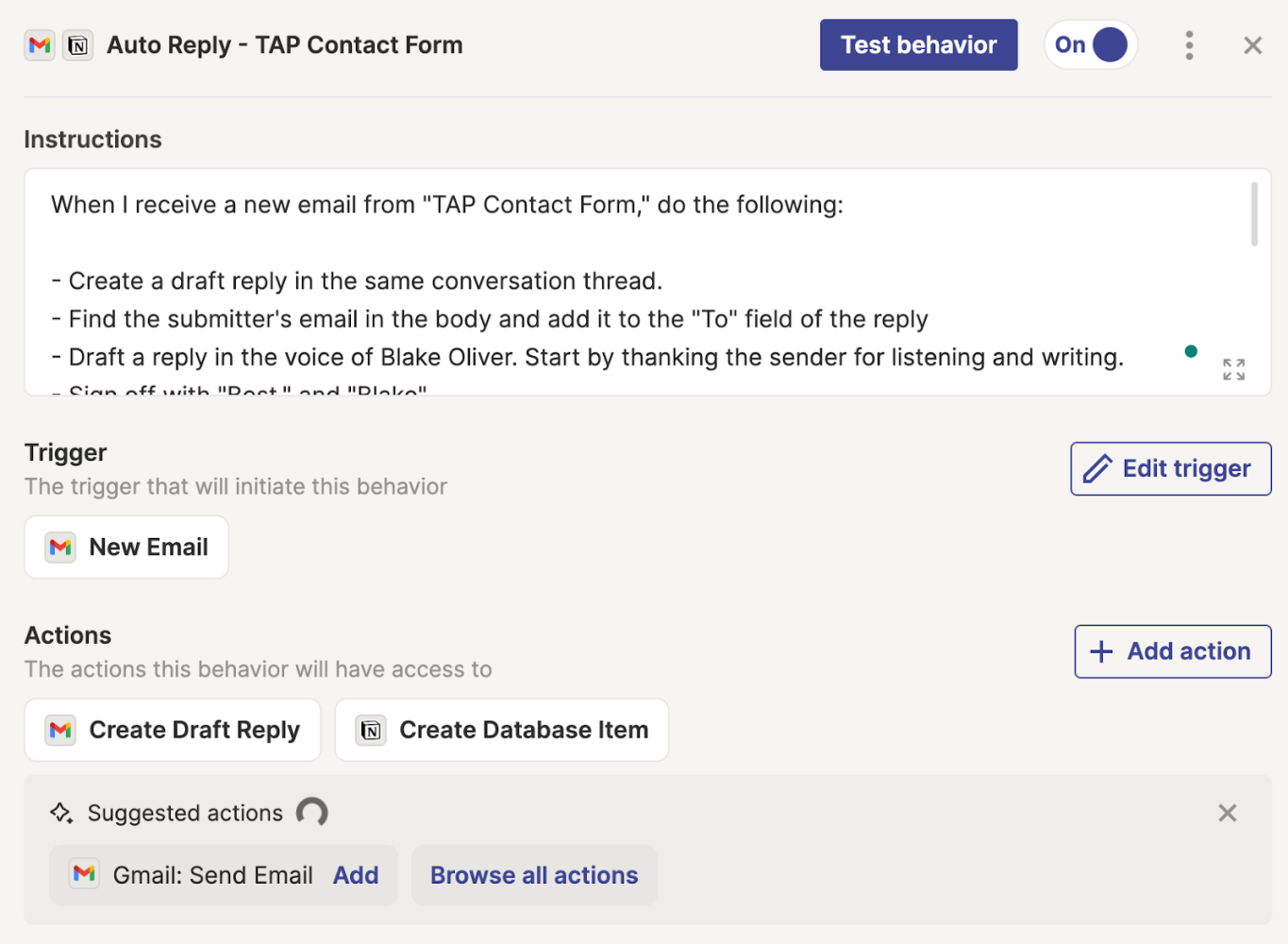
I’ve been experimenting with having Central draft emails for me. I built an agent called “Email Assistant” and gave it access to my Gmail account. Then, I created a “behavior” with instructions to monitor my inbox for emails from our podcast contact form.

We get daily emails from listeners of The Accounting Podcast, and I read and respond to every single one. There are a few things that are annoying about the process.

  • The email comes from a different email address than the listener’s, so I have to copy/paste the listener’s email into the “To” field.
  • I have to add my co-host to the CC field so he’s in the loop.
  • I have to draft the email, which typically includes similar phrases. For instance, I start by thanking the sender for listening and writing in.
  • I tend to sign off in the same way every time, but I still need to type it because I don’t always use the signoff, and I don’t want it in my email signature

To get the Email Assistant to do all this for me, I gave it the following instructions:

When I receive a new email from TAP Contact Form, do the following:

– Create a draft reply in the same conversation thread
– Find the submitter’s email in the body and add it to the “To” field of the reply
– Draft a reply in the voice of Blake Oliver
– Start by thanking the sender for listening and writing
– Sign off with ‘Best, Blake’

Only draft replies to emails from the Tap Contact Form. Ignore emails not related to this.

Here’s what that looks like in Zapier Central:

When I do this task manually, after sending my reply, I copy the sender’s original email into my database of potential stories for my podcast (so I don’t forget to read it during our Listener Mail segment). Fortunately, my database, Notion, connects to Zapier. So, I added the instructions for my Email Assistant to get the AI to do that for me, too:

Then, please create a new database item in Notion. For the item’s name, make a name for the item that represents the topic of the message. Briefly summarize the listener’s question or comment in the notes field, and then put the listener’s name, email, and message in the body of the page.

This behavior triggers when I get a new email from the contact form. Then, it can create draft replies and database items in Notion through actions I’ve configured. Those are the only two things it can do – it can’t send the email to me. But it could if I wanted it to.

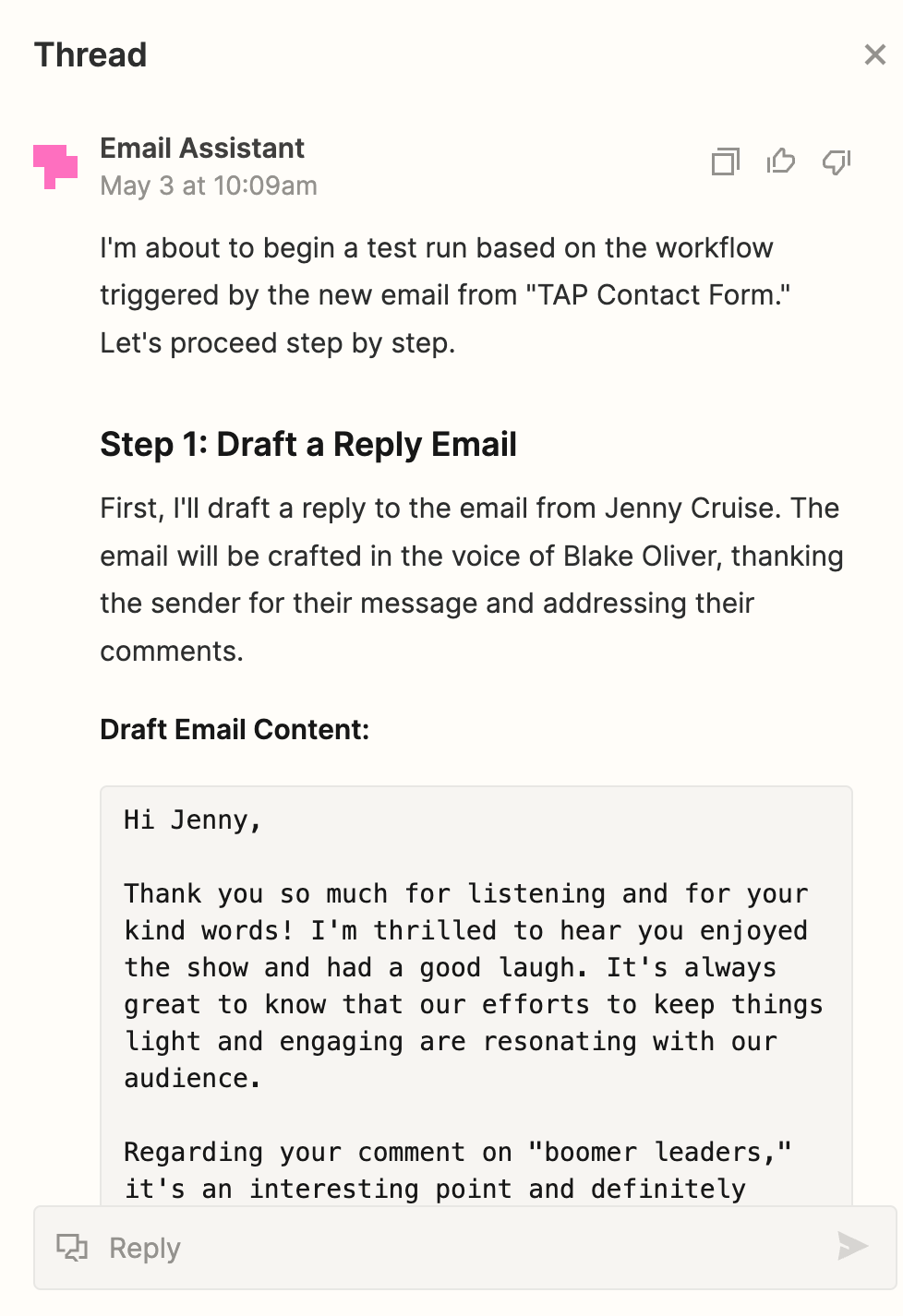
Here’s the agent thinking through what to do with a test email:

It worked!

Using AI Agents in Public Accounting

That got me thinking about how you could use AI agents in an accounting firm.

Let’s say that you’re tired of responding to requests from clients for information on how their tax return is going. You could create an agent with a behavior that says, “Every time I get an email asking about the status of a tax return, draft a reply letting the client know the status.”

But how would the AI agent know the status of the tax return? By connecting it to a spreadsheet – or perhaps your practice management software, if it’s sophisticated enough to work with Zapier.

Zapier lets you connect multiple data sources, such as Airtable, Google Sheets, Google Docs, Notion, etc.

Imagine if you had a Google Sheet where you tracked every tax return and the status of that return – not started, in progress, expected delivery date, any issues, etc.

You could then connect that data source to this AI agent and instruct it: “When a client asks about the status of their return, check the tax return spreadsheet and draft a reply with the status, who is working on it, and when we expect to complete it. Also, if the spreadsheet says we’re missing information, reply with a list of what we still need.”

You may need to add more detail about what columns to look in for each piece of information, but you get the idea. You’re programming the AI agent in plain English.

Using AI Agents in Corporate Finance

Here’s an example of how you could use an AI agent in corporate accounting. The Accounts Payable team. How often do they get the same email inquiries from vendors or customers?

Let’s say a vendor is asking about the status of the payment. Your email agent could watch for those emails and then automatically draft replies, letting them know when they will get paid or if something is holding up payment. You just have to connect your AP system to Zapier or sync the data to a spreadsheet that Zapier can watch.

You could create another behavior where if a customer requests a W-9, the AI agent sends an email with the signed W-9 attached. That’s one you could consider fully automating because it is low risk. You could choose to allow the agent to send the email without review.

Potential Uses Go Way Beyond Email

An important thing to note is that you don’t have to use this for email. This is just how I’ve been playing with it. You can trigger these agents with actions in thousands of apps. And these AI agents can then do stuff in thousands of apps.

There’s also a scheduling feature. This means triggers can be time-based, not just based on what happens in another app. You could schedule a behavior to run every day, every hour, every month, or every week.

Maybe that behavior is asking for a status update from your team on a particular project. For example, “If I haven’t received an update in so long, email the project owner and ask for an update.”

Now that I think about it, my own CEO job might be the first thing I automate.

AI Agents Are Happening Now

I don’t want you to think these AI agents are perfect; they are far from it. It’s brand new, so there will be things that don’t work right.

This behavior I showed you here is the one of three that worked well. The other two had some issues. So, don’t lose hope if you create an AI agent that doesn’t work exactly right. It’s going to take some time for these agents to work perfectly.

The important thing to take away from this is that AI agents aren’t just some far-off, futuristic concept – they’re a reality already starting to transform how we work right here and now.

I’ll keep sharing what I learn about AI agents, so subscribe to The Accounting Podcast and follow our LinkedIn page to see what I come up with.

Accounting’s Wild Ride: Private Equity, Burnout, and AI

David Leary · April 18, 2024 ·

The accounting industry is in the middle of a wild ride! Private equity money, work-life balance drama, AI taking over – it’s enough to make your head spin. Blake Oliver and I dug into all these topics in our latest episode of The Accounting Podcast.

Through all the craziness, one thing’s clear: accountants have got to stay on their toes to make it in this business. Embrace the new, take care of yourself, and sharpen those skills – that’s the trick.

Will Private Equity End the Partnership Business Model?

You know it’s serious when a heavyweight like Grant Thornton gets gobbled up by private equity. New Mountain Capital swooping in shakes up the partnership model that’s been the foundation of accounting for decades.

In partnerships, profits end up lining partners’ pockets instead of getting pumped back into the firm. Private equity cash could be just what’s needed to drag firms into the future. Blake nailed it on the show: “The argument in favor of this sort of investment is that private equity can invest in modernizing technology, modernizing the firm in a way a partnership doesn’t.” 

But here’s the catch – private equity folks want their dough, which could mean partners’ paydays take a hit down the road. Accounting firms have to thread the needle – get that sweet private equity money but keep the partner track golden so that staff want to work hard and stick around to get there.

To Attract Talent, Firms Must Improve Work-Life Balance

Speaking of incentives, our discussion on working hours and job satisfaction in accounting was eye-opening. According to a report by Big 4 Transparency, a crowdsourced compensation website, the big cheeses – equity partners – are grinding 50+ hours a week on average.

“Could this be part of the problem with convincing people to stay in accounting?” Blake pondered. “You would think that the longer you stick around, the better off you’d be. You make more money. But you also work more hours, so it doesn’t add up.” 

Could this be part of the problem with convincing people to stay in accounting? You would think that the longer you stick around, the better off you’d be. You make more money. But you also work more hours, so it doesn’t add up.

Blake Oliver, CPA

And get this: No accounting firm had an average workweek of 40 hours or less.

Accounting firms have to tackle work-life balance head-on to keep top talent from running for the hills. Flexible work schedules, using tech to work smarter, not harder – firms need to get creative. Young people want a life outside work, and if we don’t get with the program, we’re going to lose out on the best of the best.

Artificial Intelligence Could Help

AI is about to shake things up big time in traditional accounting. ChatGPT and tools like it paint a wild picture – AI-powered insights transforming how we crunch numbers and dazzle clients.

Blake shared a great example: “When I met with clients as a manager, going over their financials, clients would have a question. And in the meeting, I couldn’t answer their question right then and there because I would have to go and do some research. But if I could use a chatbot to ask the question, I could review the answer real quick and then maybe give them the answer right then and there, rather than saying, I’ll do some research and get back to you. That saves a lot of time.”

The trick is using AI to make us accounting pros look good, not put us out of a job. With AI doing the heavy lifting on numbers and insights, we can focus on the high-value stuff clients need. But to make AI work for us, accountants must carve out time to level up their tech skills.

Navigating the Future

Accounting is at a fork in the road, juggling private equity plot twists, work-life balance meltdowns, and AI’s world takeover. It’s a wild ride! But every stomach-churning dip is a chance to throw our hands up and holler. Stay loose, take care of your crew, and always be first in line for the latest tech – that’s how we’ll come out of this ride, grinning.

To stay updated on the latest in the accounting profession, listen to me and Blake Oliver ride the accounting roller coaster every week on The Accounting Podcast.

  • « Go to Previous Page
  • Page 1
  • Interim pages omitted …
  • Page 10
  • Page 11
  • Page 12
  • Page 13
  • Go to Next Page »

Copyright © 2026 Earmark Inc. ・Log in

  • Help Center
  • Get The App
  • Terms & Conditions
  • Privacy Policy
  • Press Room
  • Contact Us
  • Refund Policy
  • Complaint Resolution Policy
  • About Us